


In a Nutshell
Best steak thickness by cooking method:
- Pan Searing & Grilling (Hot and Fast): 1 to 1 1/2 inches (2.5–3.8 cm) → ideally 1 1/2 inches (3.8 cm)
- Forward Sear: 1 1/2 to 3 inches (3.8–7.6 cm) → ideally 2 to 3 inches (5–7.6 cm)
- Reverse Sear: 1 1/2 to 2 1/2 inches (3.8–6.3 cm) → ideally ~2 inches (5 cm)
- Sous-Vide: 1 to 2 1/2 inches (2.5–6.3 cm) → ideally 1 1/2 to 2 inches (3.8–5 cm)
The ideal thickness of a steak depends on two main factors: the cut itself and the cooking method you plan to use. In most cases, a steak that’s about 1 1/2 inches (3.8 cm) thick is a great all-around choice. It’s one of my favorite thicknesses because it works well with most cooking methods, though in some situations, choosing a slightly thicker steak makes more sense. Just keep in mind, this guideline applies to cuts like ribeye, strip, or filet.
Not all steaks give you that kind of choice. Steaks like flat iron, flank, hanger, or skirt steak are naturally thin. That’s just how they’re cut from the animal. You can’t make them thicker.
Before I get into which thickness works best for each cooking method (and why), let me explain why steak thickness matters so much in the first place.
Why Does Steak Thickness Matter?
How thick your steak is makes a big difference in how it cooks. If a steak is too thin, it cooks through so quickly that the surface doesn’t have enough time to brown properly, leaving you with little to no crust. On the other side, an overly thick steak can brown too fast on the outside while the inside stays undercooked or even cold in the center. That’s why picking the right thickness really matters.
Thicker steaks are great for slower cooking methods. Thinner steaks, on the other hand, are best for fast, high-heat searing (just a few minutes in the pan and they’re ready).

Best Steak Thickness by Cooking Method
For most cooking methods, I recommend a steak that’s about 1 1/2 inches (3.8 cm) thick. It’s a solid all-purpose thickness that makes it much easier to get that perfect balance: a nice crust on the outside and a tender, juicy center. Sometimes a little thicker is even better if you want more control over doneness. With a steak that thick, you have plenty of time to build a rich, flavorful crust before the inside goes past medium-rare. But please remember, it’s not a one-size-fits-all rule.
The perfect thickness can change depending on your cooking method, the type of steak, and the level of doneness you’re aiming for. That’s why I’ve put together a quick guide below, so you can see what thickness works best for different cooking methods.
Best Steak Thickness for Pan Searing & Grilling (Fast Cooking)
For pan searing or grilling over direct heat, I find that steaks between 1 and 1 1/2 inches (2.5 to 3.8 cm) thick work best, with 1 1/2 inches (3.8 cm) being the sweet spot. That thickness makes it easy to build a great crust, while still letting the inside cook evenly to medium-rare or medium.

You can technically pan-sear or grill steaks up to 2 inches (5 cm) thick over direct high heat, but once you go thicker than 1 1/2 inches (3.8 cm), the inside tends to cook unevenly while the outside develops a too-dark crust. On the other hand, if your steak is under 1/2 inch (1.25 cm) thick, it cooks so fast that you barely get any crust at all.
If your steak is thinner than 1 1/2 inches (3.8 cm), stick with fast, direct-heat cooking methods. In my experience, that’s the most reliable way to cook thinner steaks well.
You may also want to check out my other guides:
Best Steak Thickness for Forward Sear
For the forward sear cooking method, thicker steaks work best. Aim for steaks at least 1 1/2 inches (3.8 cm) thick, ideally 2 to 3 inches (5 to 7.6 cm) thick.
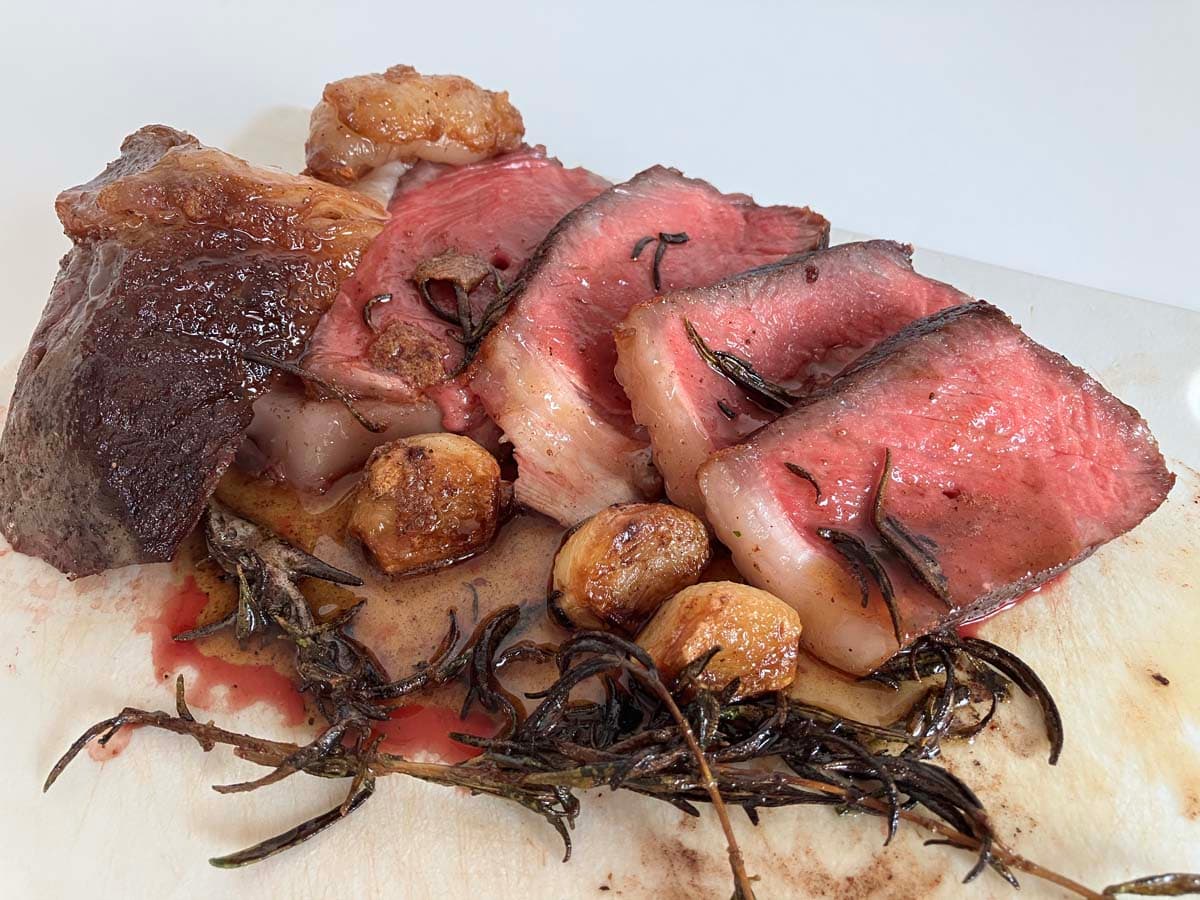
Forward sear (front sear) is a two-step cooking method in which you sear the steak first over direct heat in a pan or on a grill to build a crust. After that, you finish cooking it at a lower temperature (using indirect grill heat, a smoker, or an oven) so the steak cooks evenly on the inside and reaches your target doneness without burning the exterior. This method works best for very thick cuts that you can’t cook using direct high heat alone.
A forward sear is not for thin steaks, such as those about 1 inch (2.5 cm) thick. With a steak that thin, you can build a good crust and hit your target doneness just by cooking over direct high heat. If you want to see how the forward sear works step by step, check out my guide on how to forward sear a steak.
Best Steak Thickness for Reverse Sear
Reverse sear works best with thicker steaks. You’ll get the best results with cuts that are at least 1 1/2 inches (3.8 cm) thick. I usually go with cuts about 2 to 2 1/2 inches (5 to 6.3 cm) thick. You can reverse-sear thicker cuts, but at some point, the low-temp stage starts to take way too long.
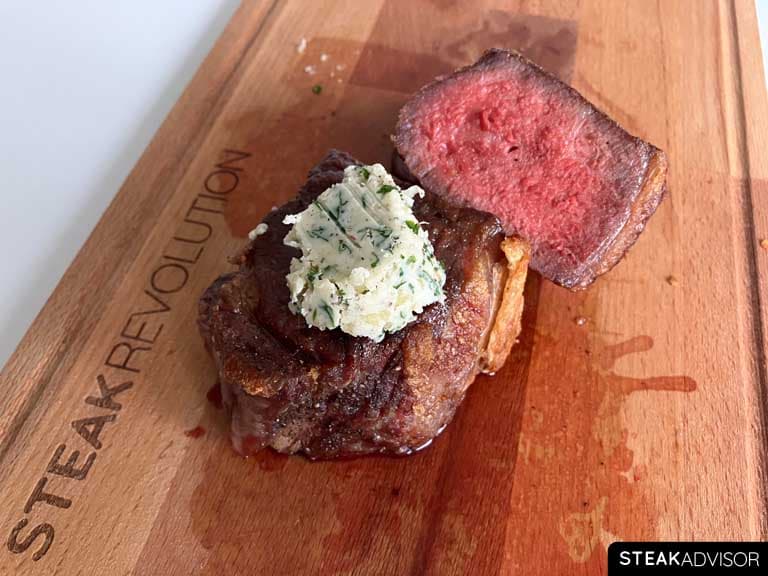
Reverse sear is a two-step cooking method in which you cook the steak first at a lower temperature (in the oven or over indirect grill heat) so it cooks evenly from edge to edge. Once the steak is close to your target doneness, you finish it over direct high heat in a pan or on a grill to build a flavorful crust.
Reverse sear is not for steaks that are 1 inch (2.5 cm) thick or thinner. Thin steaks cook too fast and are very easy to overcook when you move them from low heat to a hot pan or grill. For steaks that thin, it’s much easier to cook them entirely over direct high heat in a pan or on the grill.
Best Steak Thickness for Sous Vide
For sous vide, steaks in the 1 to 2 1/2 inch (2.5–6.3 cm) range work best. Personally, I usually stick to steaks around 1 1/2 to 2 inches (3.8–5 cm) thick.
Technically, you can sous vide a steak of almost any thickness, but that doesn’t mean you should. The problem isn’t the sous vide step, it’s the final sear. After the steak comes out of the water bath, you still need to sear it to build a crust. To get a good crust, you need very high heat, and thinner steaks overcook fast during that final step. There are ways to reduce that risk, but honestly, it’s usually not worth the extra effort. Steaks thinner than 1 inch (2.5 cm) are better cooked directly in a hot pan or on the grill. It’s quicker, easier, and you’ll get better results.
Thicker cuts are a different story. You can sous vide steaks that are even 3-4 inches (7.6-10 cm) thick, but it comes at a cost: time. While sous vide doesn’t require babysitting (you can set it and walk away), it still takes hours for very thick cuts. If your goal is a really thick steak cooked relatively quickly, sous vide isn’t the most practical option. In that case, I recommend using a forward sear instead, especially for steaks thicker than 3 inches (7.6 cm).
The Bottom Line
Above, I listed the recommended steak thickness for different cooking methods. There’s just one more thing worth pointing out. While it is possible to cook a 1-inch (2.5 cm) steak using a two-stage cooking method such as sous vide or the reverse sear, in practice, it doesn’t make much sense. Thin steaks are just easier to cook over direct heat. A quick, hot sear takes about 5 minutes, instead of spending much longer on a multi-step method.
If I had to pick one ideal steak thickness, it would be 1 1/2 inches (3.8 cm). That thickness works well with almost any cooking technique. Thinner than that? Cook it hot and fast. Thicker than that? Use a two-stage method: cook it at low heat to cook it evenly inside, then finish it at high heat to build a good crust.
And if you’re worried a thicker steak might be too big for you, share it. In my opinion, it’s always better to buy one thicker steak instead of two thin ones. Thicker steaks are easier to cook and give you more room for error.

Steak Thickness FAQs
Can a steak be too thick?
Yes, but it depends on how you plan to cook it and how done you want it.
Take a 2 1/2-inch (6.3 cm) steak, for example, and try to cook it hot and fast. By the time the outside gets a good sear, the inside will still be undercooked. Leave it any longer, and the exterior will burn. In that case, the steak is too thick for that cooking method.
Now take a really thick steak, about 3 inches (7.6 cm), and cook it sous vide or with a reverse sear. It’ll work, but it’ll take hours. In most cases, it makes more sense to cut it in half and cook two 1 1/2-inch (3.8 cm) steaks instead. They’ll cook much faster, with no difference in flavor or crust.
So yes, a steak can be too thick. Not because it’s impossible to cook, but because thicker cuts can burn on the outside, stay undercooked inside, or take hours to finish, depending on how you cook them. Choosing the right thickness for the cooking method will give you better results with less time and effort.
How about naturally thin cuts?
There’s nothing wrong with thin steaks at all. As mentioned earlier, anything thinner than 1 1/2 inches (3.8 cm) is just easier to cook hot and fast, like in a pan or on the grill. You just need to use the right technique to build a good crust while keeping the inside pink, juicy, and tender.
Thin steaks cook very quickly, so you don’t have much room for mistakes. That’s really the only downside. Still, it’s not a problem if you know what you’re doing. On Steak Advisor, you’ll find plenty of guides focused on cooking naturally thinner cuts, and in most cases, you can still get a nice crust without overcooking the inside.
Take the example below: this is a 1/2-inch (1.25 cm) ribeye with a decent crust and a nicely pink inside. It’s proof that thin steaks can turn out great. And trust me, if I can do it, you can too. I’ve even shared a recipe that walks you through exactly how I cook a very thin steak.
