


You’ve probably heard that more marbling means a better steak, but that’s not always true. In this guide, I’ll break down what marbling is, why it matters, and how it affects the way a steak cooks and tastes. I’ll also go over which type of fat really improves flavor, how it differs from other fats in beef, and what role marbling plays in beef grading.
What is Steak Marbling?
Steak marbling refers to the white streaks and small flecks of intramuscular fat found within the muscle fibers in any cut of beef. This fat is what gives the meat its characteristic marble-like appearance, which is where the name comes from.
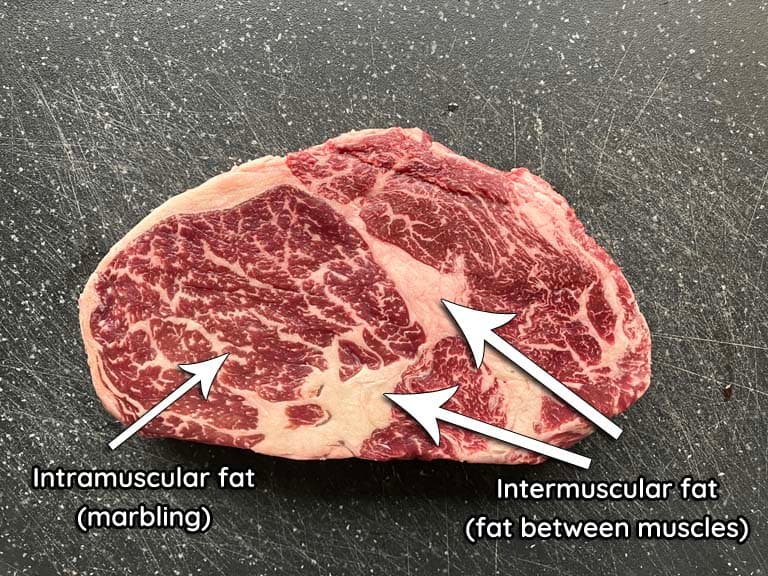
Intramuscular fat is not the fat around the meat. It sits within the muscle. Please also do not confuse the intramuscular fat (marbling) with subcutaneous fat (the fat beneath the skin) and intermuscular fat (the fat found between separate muscles). Of all those fat types, only intramuscular fat significantly affects the steak’s texture and flavor.
Below, I’ll show you the differences between these types of fat using photos.
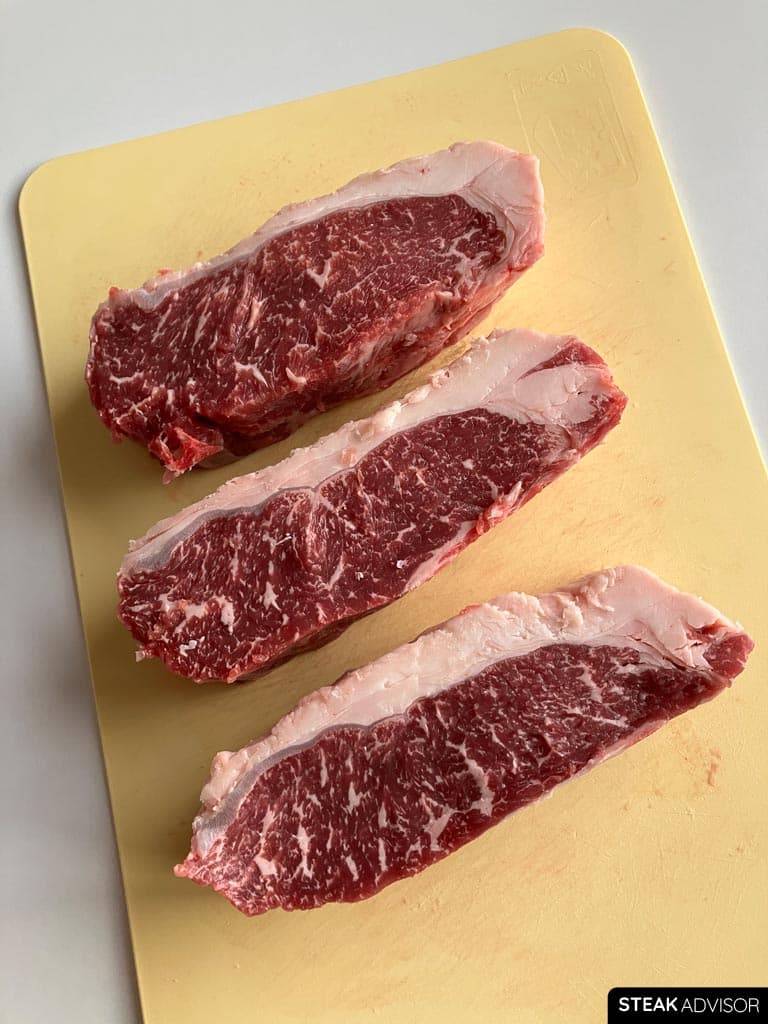
In the first photo, you’re looking at a strip roast, which is where strip steaks come from. The striploin is made up mostly of one muscle, so there’s usually no fat between muscles. What you do see is the outer fat layer (subcutaneous fat), along with marbling (intramuscular fat) inside the meat.

The second photo shows a ribeye, one of the most marbled cuts of beef. Because ribeye is made up of several muscle groups, it’s a great example of both intermuscular fat (between the muscles) and intramuscular fat (marbling within the muscle). You can clearly see how these fat types differ.
Steak Marbling Examples:
Below, I’ve included a few more photos to show you how marbling looks across different cuts of beef, from very lean to heavily marbled.


Why Is Marbling So Important in Steak?
Marbling, or intramuscular fat, is what makes a steak taste better, stay juicier, and feel more tender when you bite into it. When cold, that fat is firm and waxy. But as it heats up, it starts to melt and slowly lubricate the muscle fibers from the inside, which is exactly what makes a well-marbled steak so satisfying to eat.
Fat is also where much of a steak’s flavor comes from. As the marbling melts, it adds richness and depth to the meat, and with heavily marbled steaks, you can even get a slightly sweet, buttery flavor. That’s why steaks with more marbling taste more satisfying. If you enjoy a really rich, sweet flavor in your steak, choose the one with more marbling.
Marbling also affects tenderness. A higher fat-to-muscle ratio means there’s less resistance when you bite into the steak, making it easier to chew once that fat starts to melt. With very highly marbled steaks, the texture can be so soft that it almost feels like biting into butter. That kind of tenderness comes from the high amount of intramuscular fat. Of course, this only works if the steak is cooked properly and the fat has enough time to render fully.
What Most People Don’t Know About Marbling
Intramuscular fat (marbling) needs to reach an internal temperature of roughly 130–140°F (54–60°C) to melt effectively. That’s why well-marbled steaks should be cooked to at least this range. Anything below 130°F (54°C), and the fat stays firm and waxy instead of rendering, which means you’re not getting the full benefit of that marbling.
Melted intramuscular fat is also what makes well-marbled steaks more forgiving to cook. Lean steaks rely mostly on water to stay juicy, and that moisture cooks off fast. The intramuscular fat doesn’t evaporate as water does during cooking. Instead, it melts and renders, helping protect the meat from drying out. Which means you can cook highly marbled steaks past 140°F (60°C) and they’ll still stay fairly juicy and tender compared to leaner steaks. Sure, the more you cook any steak, the more moisture and tenderness you lose. But if you like your steak cooked more than medium-rare, choosing a well-marbled cut makes a big difference.

An interesting thing about marbling is that there’s a point where it can become too much. Top-grade Japanese Wagyu Beef is a perfect example. It’s incredibly tender and juicy, but the richness can be overwhelming in larger portions. That’s why Wagyu is usually served in small portions or as tasting-style cuts rather than as a full-size steak.
That said, the final results always depend on a few things: the specific cut, the amount of marbling, and most importantly, the cooking method. Overcook the well-marbled steak, and you can still lose everything marbling has to offer, ending up with meat that’s dry, tough, and chewy. That’s why cooking it to the right temperature matters just as much as starting with a good piece of beef.
Now that you know why marbling matters, let’s look at the role it plays in beef grading.
The Role of Marbling in Beef Grading
Beef is graded based on several factors, including marbling, the animal’s maturity, and other carcass characteristics. That final grade gives you a quick idea of the steak’s overall quality before you buy it. Marbling plays a major role in beef grading because it is one of the most reliable indicators used across grading systems. No matter the country, the type of beef, or the grading system, marbling is always taken into account when determining the final beef quality grade.
In general, more marbling means better flavor, a juicier steak, and a more enjoyable eating experience. That’s why the amount of marbling has a big influence on the final beef grade. That grade also affects price. Beef with more marbling is graded higher and typically costs more, which reflects how grading systems value marbling as a quality characteristic.
For example, in the United States, most beef is graded by the USDA (United States Department of Agriculture). The USDA beef grading system evaluates several factors, with marbling being one of the most important. The main grades range from Prime, which has the most marbling, to Choice, and then Select, with each lower grade showing less marbling.


That said, not all beef in the United States is graded by the USDA alone. In some cases, brands use their own grading standards. A good example is American Wagyu. Companies like Snake River Farms use a hybrid approach, combining USDA grading with the Japanese Beef Marbling Score (BMS) to better reflect the higher marbling levels in their beef.
Now, if you look beyond the U.S., you’ll find different beef grading systems around the world, and they don’t all weigh factors the same way. But one thing never changes: in every grading system, marbling is among the most important factors.
To learn more, check out my comprehensive guide to beef grades.
Factors That Affect Marbling in Beef
Marbling depends on several factors, but breed, diet, and how the cattle are raised matter the most. Here’s a quick breakdown of how each one affects marbling.
- Breed of cattle: Genetics matter more than anything else when it comes to marbling. Some cattle are better at producing intramuscular fat. Japanese breeds such as Kuroge Washu (Japanese Black), Mukaku Washu (Japanese Polled), Nihon Tankaku Washu (Japanese Shorthorn), and Akage Washu (Japanese Brown), as well as American Black Angus, are good examples. Even with the same diet and raising methods, these breeds tend to develop more intramuscular fat than most other cattle breeds. That difference comes down to genetics.
- Diet: What cattle eat matters a lot. High-quality feed, especially grain- and corn-based diets, helps the cattle develop better marbling than a grass-only diet. Feeding timing also plays an important role. The length of time cattle are fed, and the stage of their growth, directly affect the amount of intramuscular fat that develops.
- Raising methods: The way cattle are raised is just as important. A proper environment, low stress, and good overall care all contribute to better marbling. Japanese Wagyu is a great example. Strict breeding and raising standards require cattle to be kept in low-stress conditions and given exceptional care, which directly affects beef quality, including marbling.
I’ve focused on the main factors here to keep things clear and easy to understand. There are other factors involved as well, but their impact varies depending on the farm, feeding program, and overall management.
Steak Marbling FAQs
What is the most marbled type of beef?
Wagyu beef is the most marbled type of beef, hands down. Compared to regular beef, Wagyu has significantly more intramuscular fat, which is what gives it that rich flavor and buttery texture.
Among all Wagyu, Japanese Wagyu sits at the top. It’s considered the best in the world. Well-known Japanese Wagyu brands like Kobe beef, Matsusaka beef, Olive Wagyu, Yonezawa beef, and Omi beef are famous for producing consistently high-grade beef with exceptional marbling. That level of quality comes from a combination of genetics, strict breeding standards, controlled diets, and low-stress raising conditions.
Outside of Japan, Australian Wagyu and American Wagyu are the next best options. They usually don’t reach the same extreme marbling levels as top-grade Japanese Wagyu, but they still have far more marbling than any regular beef.
Do well-marbled steaks taste better than lean steaks?
Taste is very personal, but for most people, well-marbled steaks taste better. The intramuscular fat makes them richer, juicier, and more flavorful overall. That doesn’t mean lean steaks are bad, though.
Lean cuts just don’t have that rich, slightly sweet flavor you get from heavily marbled beef. Instead, they taste more beefy and straightforward. That’s something I personally enjoy a lot. A good example is hanger steak. It’s a fairly lean cut, but it has a deep, bold beef flavor that pairs especially well with something like chimichurri sauce.
At the end of the day, it comes down to what you like. If you’re new to steak and not sure what to choose, I’d recommend starting with a more marbled cut. The richer flavor is easier for most people to enjoy.
What are the most marbled steak cuts?
Some steak cuts are naturally more marbled than others. Ribeye steak, ribeye cap steak, outside skirt steak, Denver steak, and flat iron steak are among the most marbled cuts you’ll find. There are other cuts, like strip steak or picanha, but their marbling can vary a lot depending on the type of beef and its grade. Ribeye is the most consistent. It’s one of the most flavorful steaks, mainly because it’s naturally more marbled than almost any other cut on the cow, no matter the grade.
For more cuts, check out my guide to the fattiest cuts of steak.
The Bottom Line
Marbling is one of the most important factors to consider when choosing a steak. If you like steak that’s rich, juicy, and tender, go for a more marbled cut.
Even steaks with the same grade can look very different, so don’t just grab the first one. Take a moment to compare a few and pick the one with better marbling. For most people, a well-marbled USDA Choice steak already tastes great. But if you’re looking for even more richness and tenderness, a well-marbled USDA Prime steak is a great option, especially for a special occasion.
If you’re new to steak, there are plenty of guides here on Steak Advisor to help you get started, including one on how to choose a good steak. I created this site with one simple goal: to help people cook better steak at home. If you’re looking for answers to a specific steak question, the easiest place to start is the menu, the search bar, or the homepage.